My grandmother in the Virgin Islands in the 1950s. She and my grandfather went there to get a divorce. They ended up having a fine romance. And getting the divorce.
I've been working on a different kind of memoir. It's about nakedness, lingerie, and the women in the family. Haven't yet decided which chapter goes first. So, UNDERNEATH IT ALL might start -
My grandmother loved to undress. First, the shoes – low-heeled Ferragamos, which she stepped out of in front of her open closet door. Then the cashmere twin-set, unbuttoned and hung on padded hangers. Finally, the skirt, linen or wool depending on the season, unzipped and clipped into a wooden skirt hanger. “Ah,” she’d sigh and take a sip of vermouth-and-soda mixed in a short glass with a twist of lemon. After that, she padded around in her underwear for a bit whistling tuneful unidentifiable melodies...
Or it might start -
We realized that my mother had it in for the neighbors when she chopped down their pine tree. It was just an immature sapling sprouting in the little grove that separated our yard from theirs, but they were upset. In fact, they rarely spoke to us again, which may have been my mother’s intention. I say ‘may’ because, for a person with a saw in her hand, she professed a remarkable degree of innocence. She appeared in the kitchen with fibrous shreds still clinging to the saw’s shiny, sharp teeth and announced in a bemused tone, “I think I just cut down the Sedgwick's tree.” She set her weapon on the table and bent to pick up sawdust that fell onto the floor...
Either way, I'll let you know more as work progresses.
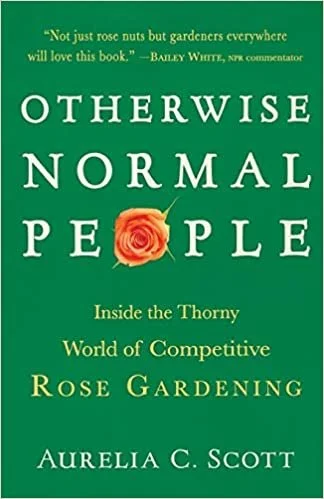
Meanwhile, I'm still celebrating the awards from the Garden Writers Association for OTHERWISE NORMAL PEOPLE and Writer's Digest for the essay MY MOTHER'S BRAIN! I've posted the essay in Selected Writing. More on ONP below.
OTHERWISE NORMAL PEOPLE - Winner of the Gold Award as Best Written Book of 2008 from the Garden Writers Association of America
Critics rave: Otherwise Normal People is Fascinating, Vividly Engaging, and Colorful.
"What lengths we go to in our lives for plants! Not just rose nuts, but gardeners everywhere will love this book. I found myself laughing out loud and nodding with sage understanding -- sometimes at the same time." - Bailey White, NPR commentator
"Q-tips, cotton balls, and hazmat suits: welcome to the world of competitive rose gardening. Aurelia Scott's engaging journey into the underbelly of rose exhibitions will leave you wondering, Are these hobbists bloomin' nuts, or simply having more fun that the rest of us?" - William Alexander, author of The $64 Tomato
"Aurelia Scott has nurtured a wonderful bloom: a rose book for roasarians and people who can't tell a bourbon from a tea. Reading this delightful, fun story of obsession made me look anew at our backyard and ask, Where's my gardening shovel?" - Mark Obmascik, author of The Big Year: A Tale of Man, Nature, and Fowl Obsession
The American Gardener, March/April 2007 -
"A single plant type can often inspire worshipful and even slightly deranged devotion, particularly when competition is involved, as evidenced by Otherwise Normal People: Inside the Thorny World of Competitive Rose Gardening. Curious about what makes rose competition participants tick, author Aurelia Scott discovered that it often starts innocently enough, say with a neglected rose bush that produces an unexpectedly exquisite bloom, and end up as a life-changing compulsion to collect and show every kind of rose imaginable. Among the stories of the rose maniacs she encounters, Scott interweaves intruiging pieces of rose history abd other fascinating bits of trivia.
Library Journal, 2/23/07 -
"Their gardens are overflowing with roses, and their homes are often decorated with rose memorabilia and trophies. They each have their own secret fertilizer formulas as well as an arsenal of odd materials to groom their prized blossoms. Who are these eccentrics? They are competitors in the highly demanding world of rose shows, and journalist Scott follows several as they spend their year grooming and maintaining their rose beauties for the next show. We meet a man from Maine who shows how he keeps his roses alive during the winter and a South Carolina couple who faces growing roses in the humid South. The ideal place for rose growing seems to be California, but that state has its share of challenges, namely, droughts and high winds. Marriages have been ruined by this obsession, and true loves have been found. The journey is a fascinating one. Readers will certainly be in suspense before the final chapters reveal who will take home the prizes at the American Rose Society's National Rose Show."
Booklist 2/15/07 -
"A rose is a rose is a rose, but don't tell that to the hundreds of self-acknowledged "rose-aholics" who wake in the middle of the night, pack up jury-rigged coolers and containers laden with pristine blossoms, and head off down the highway to compete in local, regional, and national rose exhibitions. Scott follows the most passionate of the bunch as they prepare their gardens, prune canes, protect blooms, and pinch back buds, all in the hopes of taking home crystal bowls, silver candlesticks, and, at the very least, blue ribbons proclaiming their prowess at growing some of Mother Nature's finichiest flowers. As colorful as the bouquets they propagate, Scott's rosarians represent an ecumenical cross-section of the American landscape: PhDs seek advice from long-haul truckers, first generation immigrants compete against Mayflower descendents, and long-married couples bond over blooms. With a breezy, infectious enthusiasm, Scott offers a vividly engaging account of big-time rose competition and the seemingly average individuals who take leave of their senses in this addictively sensory pursuit." - Booklist
Publisher's Weekly, 2/5/07 -
"Scott, a freelance journalist from Maine, hung out with several of the gardeners competing in the American Rose Society's 2004 spring national show. She discovered a subculture "where brain surgeons and construction workers are social equals," with a freewheeling competitive "spirit of make-do and can-do" that inspires improvisations like creating rose beds out of 40-gallon trash cans. (Two glossaries explain the classifications and other terminology for unfamiliar readers.) Scott's narrative structure-a chapter with each of her topics, building up to the competition, with a brief epilogue-is similar to the filmBest in Show , but she doesn't poke fun, and for the most part she's caught up in their "infectious" enthusiasm for roses. Whatever weight they exert on her own passion for gardening, however, remains largely unspoken. When Scott admits that her desire to practice organic gardening is dampened by her jealousy of the blooms an interview subject achieves spraying with chemicals, the personal revelation is jarring in its unexpectedness. The backseat approach frees Scott to elaborate on the outsized personalities of the gardeners she met. If only their colorful stories were matched by photographs of the flowers they raised."